"We'll contribute for weddings but won't hire a truck together"
Are expectations of Producer Associations unrealistic, and if so, what should be done?
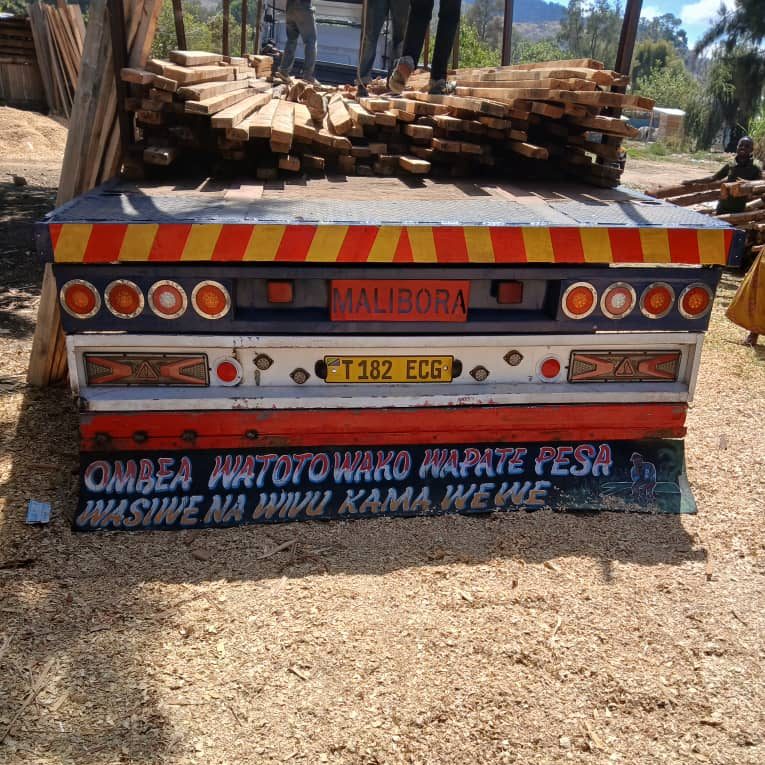
Image: Timber truck wisdom "Ombea watoto wako wapate pesa, wasiwe na wivu kama wewe"
"Pray that your children get money so they won't be jealous like you"
What programmes expect
Rural production seems fragmented and dispersed. Each person hires their own equipment or buys inputs separately. Individually, up against proactive and well-connected agents, the isolated producer has weak bargaining power.
It makes sense to expect that producer groups could bring benefits.
- Perhaps groups could buy inputs together, achieving economies of scale and saving on transport?
- Perhaps if they sold together they could negotiate better prices through strength in numbers?
- Perhaps members could share technical expertise to improve the quality of their production?
What happens in practice
Producer associations are often set up as part of development programmes to deliver these benefits. Naturally the groups have weak capacity to manage a formal association, and training is provided to improve group governance.
But producers continue to operate individually. In the case of commercial forestry, many tree growers have ready access to agents anyway - adding in the producer association would just be an extra step.
But also that's how business works, and community members themselves can explain why.
"We don't trust each other" explains a Chairman of a Tree Growers Association in the Southern Highlands. "We donate for weddings and funerals, because we're not expecting anything back. We can't afford to hire a truck to take our logs together to the veneer factories. But if we all contributed, we wouldn't trust each other to share out the profit."
Producers also tend not to share expertise.
Jealousy is common in close communities (see the truck wisdom). Why would I help my competitor get ahead?
It also doesn't occur to people to share technical knowledge. I have seen countless groups of young women chicken producers with this dynamic. While the majority of group members have a handful of chickens taking care of themselves, one group member operates professionally, with hundreds of chickens that she takes good care of and getting decent profits. But it never occurred to the other members to ask her for advice or secret of success.
What's driving the gap?
This is a case for Micro Theory of Change, i.e. Theory of Change at the activity level (rather than project level) which explains the causal mechanism through which an individual activity is expected to produce change.
In a normal Theory of Change, high level intervention strategies ("Create and strengthen producer associations", "Increase market linkages") are aggregated up to intended outcomes such as "improved revenue for producers".
But the Micro Theory of Change is missing to explain HOW producer associations will lead to joint sales or transfer of expertise. The added burden of a formal association also detracts from the core goal, as energies are focused on creating a well-managed association rather than delivering sales or economies of scale.
Why is this gap between theory and real life practice so often missed?
Cultural Theory explains why.
Hierarchy recognises the potential benefits of an Egalitarian solidarity, of group cooperation. But it overlooks the fact that solidarity and trust are relational and built organically, not created through formal structures.
The possible benefits of producer associations from the original programme design sound convincing, so hierarchy doubles down on capacity building efforts to achieve collaboration.
At the heart of the problem is a common blindspot of Hierarchy: it forgets that its own models may not be fully accurate, so it can't see the evidence on the ground that the intervention is not delivering the intended benefits.
Programme implications
Producer associations risk adding project costs without adding value. Creating producer associations does not, by itself, create incentives for joint sales or overcome trust issues. So programmes need to clarify specific outcomes and change mechanisms.
How do producers currently handle sales?
How do people actually collaborate in the community and could these ways be leveraged in some way?
Which specific market access problem will the producer association address, and how?
What are the top one or two things that producers actually want from their association?
How could project investment be targeted (with realistic change mechanisms) to truly deliver on those one or two outcomes?
Growth Mindset is key. No blame for the gaps, but dealing with reality as it is and improving programme performance through adaptive learning.
This is exactly the kind of design challenge Micro Theory of Change is designed to surface and fix.
→ Read more: Micro Theory of Change as a design method