Design Thinking.
Design Thinking is a non-linear, user-centred problem-solving approach developed in product and service design and popularised by institutions such as Stanford d.school and IDEO.
It uses iterative methods - understanding users, reframing problems, prototyping and testing - to develop solutions that can be refined in response to real-world behaviour and local conditions.
While widely used in business and innovation, it remains under-applied in international development, where its behavioural focus and iterative logic are especially powerful.
At its core, "Design Thinking" is a mindset, a toolbox and a way of structuring better conversations about problems and solutions.
How it works
1) Grounding design in real user profiles (not idealised ones)
Design Thinking starts by making sure we are genuinely clear about who we are designing for and what actually matters to them in practice.
One simple but transformative tool is empathy mapping and user personas — building realistic profiles of participants’ goals, constraints, incentives and current behaviours.
This shifts programming from designing for “beneficiaries” in the abstract to designing for real people making real trade-offs.
Many programmes change dramatically once this one practice is applied well.
2) A toolbox for creative, insight-generating thinking
Design Thinking uses a range of structured methods to help teams move beyond obvious or conventional solutions.
One example is random combination - deliberately combining two unrelated ideas to spark new options.
A recent real-world example is a trial in Uganda using treated baby wraps (combining insecticide-treated nets with baby-carrying cloths), which reduced malaria infections by two-thirds.
Another powerful tool is generating “bad” solutions first.
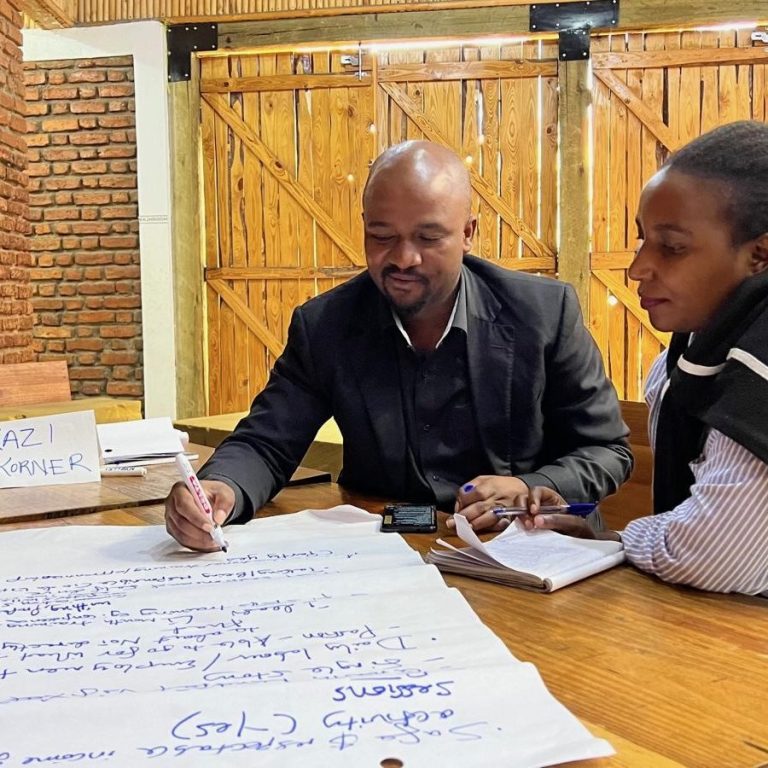
Teams are invited to design deliberately terrible interventions - and then flip them into better ones.
For example, when tackling exploitative agents who burn farmers’ woodlots, participants proposed “bad solutions” such as:
- rewarding the most aggressive agents with district prizes
- giving them free houses and schooling for their children
- running competitions to burn the most woodlots
- providing equipment to help them spread devastation faster
It sounds irreverent - but this exercise consistently unlocks a deeper level of insight and creativity.
As teams reverse these ideas, they surface what really matters: what behaviours must change, what incentives drive harm, and what a workable solution would actually need to take into account.
3) Using the Double Diamond to sharpen the problem definition
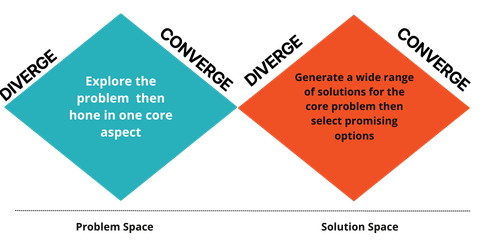
The Double Diamond, developed by the UK Design Council, is one of the most widely used Design Thinking frameworks.
It replaces linear thinking like:
Low technical knowledge → Provide training
with a more disciplined process of widening and narrowing.
First, the team explores the issue broadly.
Then they focus sharply on one specific problem.
Then they widen again to generate multiple solution options.
The "Double Diamond"
For example, weak smallholder bargaining power might stem from:
- limited collective action
- exploitative intermediaries
- lack of knowledge of market prices
- low buyer competition
- lack of financial safety nets
Each of these implies a completely different intervention strategy.
We might assume the problem is lack of price information. But digging deeper, we may find that even when farmers know prices, they are powerless to insist on higher ones.
Is the real issue negotiation skills? Informal cartels? Debt relationships?
Only once a design-critical issue is selected is the problem reframed into a clear “How might we…” question, such as:
How might we enable smallholders to negotiate higher prices safely?
How might we reduce the power of exploitative timber agents?
That question is then used to generate and test solution ideas in the next divergent phase.
Why this matters for development
Design Thinking helps teams:
- avoid locking into the wrong problem too early
- design for real behaviour rather than assumed behaviour
- widen the range of possible interventions
- test ideas early, cheaply and safely
- adapt intelligently to local realities